Englisch
  Deutsch
Committed to Microscopy
Interview with Erin Tranfield Leder of BioImaging Core (VIB, Ghent) and host of the Tech-EM seminar
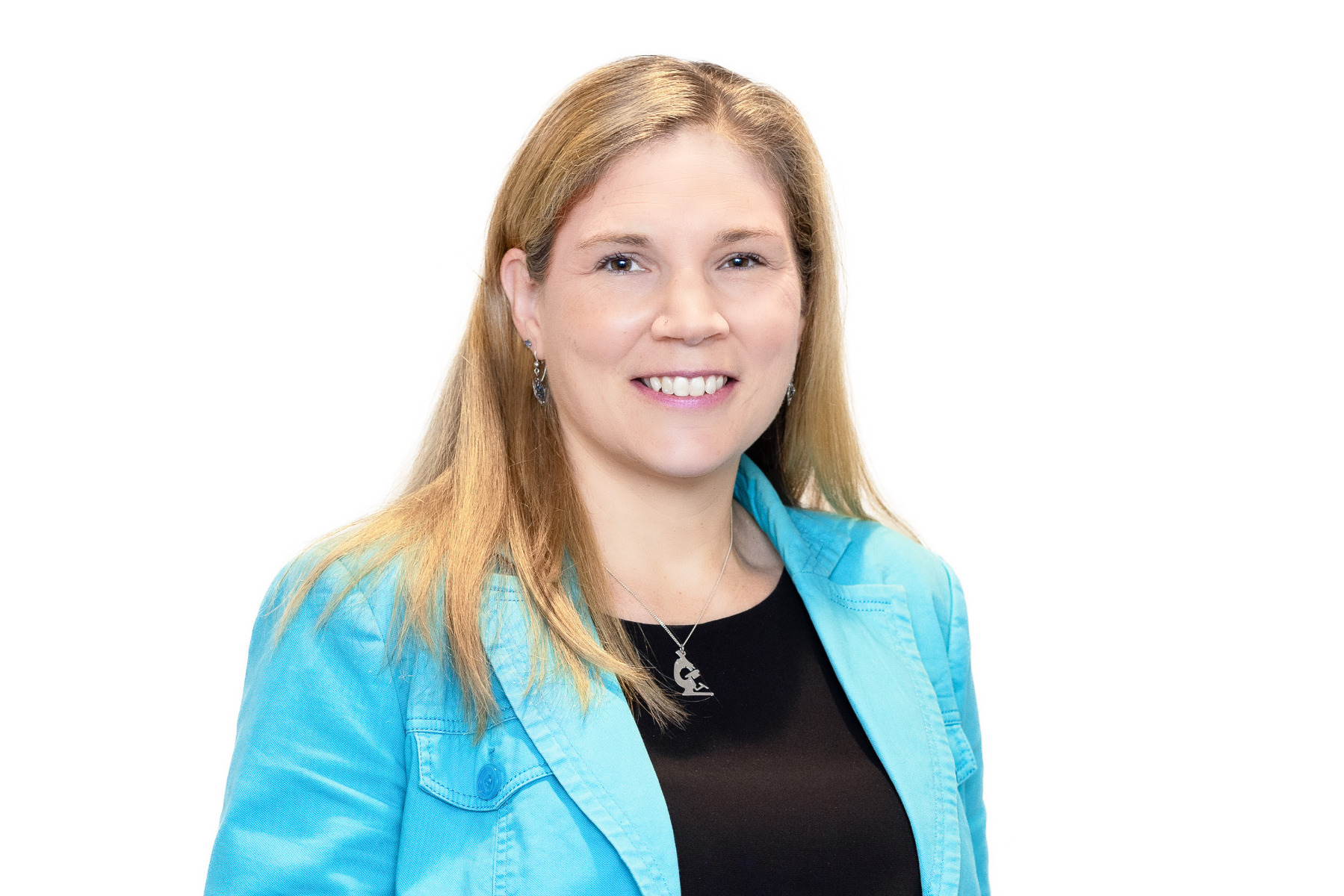 Erin Tranfield
■ PhD in Pathology and Laboratory Medicine at
the University of British Columbia (Canada)
■ Postdoc at NASA Ames Research Center (USA)
■ Postdoc at the European Molecular Biology
Laboratory (EMBL) (Germany)
■ 2013-2024: Built and led the EM Facility at the Instituto Gulbenkian de Ciência (IGC) (Portugal)
■ Since 2024: Leader of the BioImaging Core – Ghent for the VIB (Belgium)
■ Founder of the TechEM Seminar Series
What brought you to science and research?
I've always been interested in science and art, and Electron Microscopy is the combination of both bringing the Science together with the research. And I also like the role I have in my position here.
What is your current position and function?
I lead a microscopy core facility at the VIB in Ghent Belgium and here I have the opportunity to shape the facility in terms of instrument investment and long-term vision. Core Facilities have this very interesting challenge: Creating a resource that helps scientists easily access microscopy when they need it. And furthermore, to keep our eyes open to future developments.
So, it is important to be open to new ideas, technologies or research fields, but also to be productive or efficient at the same time.
Exactly! Where is science evolving? Where do we see the future of research? Which new technologies are coming?
We need to decide what we want to invest in and, just as importantly, what we may need to phase out. After all, we can’t keep every microscope or system indefinitely.
How do you decide which technology to invest, to keep or to phase out?
It is very important to be slightly immune to the phenomenon in science, which is the “new sexy technology” theme! Every few years new exciting techniques show up. But in a core facility we must always decide if our community really needs that new technology.
Would it really expand the science or save time? Or was this additional hour incubation time just a convenient time to go for lunch. So, we need to understand why we do things the way we do! All these aspects are important for the decision.
You are also hosting the TechEM seminar. I guess this seminar platform is also great for choosing technologies because there are experienced scientists sharing their knowledge.
That is why I like TechEM. At conferences I’m always missing the technical discussions even if people present the work they have done – The details, the “How” and “Why” is mostly missing but in TechEM we dig into the “How” and “Why” behind the methods.
How did the TechEM seminars start?
It started in April 2020 during the pandemic, when my team and I were stuck at home and I was trying to train new team members in Electron Microscopy. I thought how can I make this online training more interesting? That is really where TechEM came from.
I invited external EM scientists to our group meeting, to present techniques they are experts in. They were also invited before their talks to get an impression of the format. And so, the group became bigger and bigger. And now we have over 400 subscriptions, and it is still growing.
What are the main criteria for TechEM talks?
I've always had this wish to hear more about the details, the path to the final result and less about the result itself. So, I asked speakers to focus on this and to share - if they're willing - what didn't work as much as what did work.
Yes, the fails - nobody seems to talk about them. But isn’t it also important to learn about the things that didn’t work so that others don’t waste their time repeating them?
Exactly! No one got to their final protocol on their very first try.
And how do you pick topics?
I think it is probably very selfish, but I look for topics and techniques I want to know more about, and everybody seems to like the topics I select. And sometimes there are little themes, but we try to keep it very introductory. Like the current cryo-EM theme, which is made for the cell biology community who focuses a lot on plastic and room temperature processing.
What do you think makes TechEM so special?
I think it is that TechEM creates a safe environment where everyone can ask what they don't understand and get honest answers without being judged or feeling weird about it, regardless of age and seniority.
Is TechEM also a good platform for Students?
The TechEM stage is open to anyone who wants to present, be it a student who is just starting or a senior scientist.
Everyone is welcome and often the student talks are greatly appreciated because they present their thesis work. Students look at things from a different perspective and that helps the community grow.
Overall, the nice thing is: The speaker can set the tone! If they want help with troubleshooting or with data analysis it is a great community to ask.
What is the future of TechEM?
I've been told I'm not allowed to stop these seminars or there will be a revolt in the community! So, we will continue with a diverse program. Ideas (or self-nominations) for speakers are always welcome.
Jumping back to the past and to research. When did you start with EM?
I did SEM and TEM as part of my PhD at an era where everyone thought that EM was going to be eclipsed by the new and fancy confocal microscopy. That was the new sexy technology at that time. And I remember people saying to me, why are you wasting your time doing a PhD in old technology? Well, here we are…
What did you like about the old times when you think back?
I'm old enough that I used to do most of my data collection on plate film. Yes, a digital camera is more efficient, but there's something about developing your film in the dark room after a microscopy session - that was pretty cool. It was a warm, dark place and I would just crank up the music super loud and let the images reveal themselves.
How did you come from Canada to Europe?
So that was in 2009. When I did my first postdoc at NASA, one lady who was on the same floor as I, she did her postdoc in Europe. And at some point, Sigrid said to me that I should check out that institute which was the EMBL.
And so, I looked online, and they happened to have a position open about Electron Microscopy. It was a position made for me, so I applied and got an offer.
I always said I wanted to live in Europe, and I was crazy enough to say yes.
After your postdoc at EMBL you were leading the EM Facility in Portugal for over a decade. A year ago, you further moved to Belgium. What were the reasons for this decision? Probably, not the weather.
I definitely did not move for the weather. I miss the weather in Portugal along with some great colleagues and really good food and being close to the ocean.
All these lovely things, the reasons why we all like to go to Portugal for vacation.
But without a doubt, the research landscape is so much richer in Belgium. There are so many more funding opportunities. There is a bigger critical mass of research and biotech, which means that there's just so much happening in the research landscape. So, for me, this is really exciting, and I am enjoying the Science here at the VIB and the many possibilities.
Erin, thank you answering our questions!